


Blog Contents
Generative AI in Software Testing Use Cases and Benefits
December 31, 2025 • By Peter Stakoun
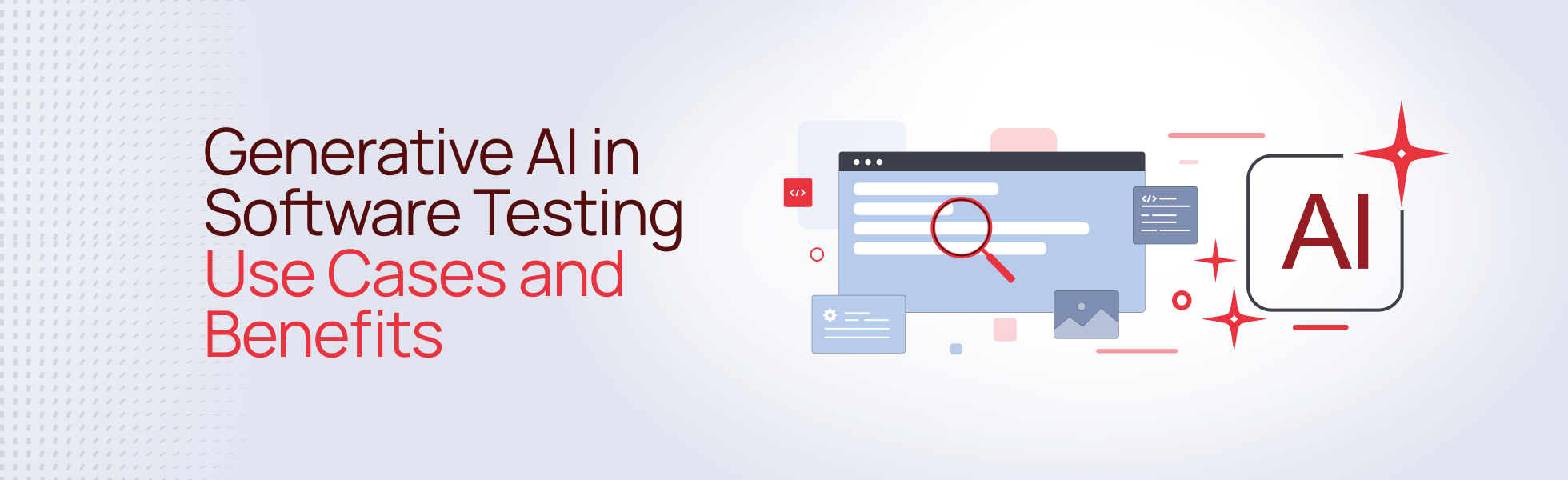
Software testing is no longer limited to scripted test cases and repetitive automation flows. With the rise of Generative AI in software testing, quality assurance is shifting from reactive testing to intelligent, predictive, and self-adapting QA systems.
AI in software testing can generate test cases and automatically analyze failures in plain language, so that QA testers can ensure product quality. In this guide, we’ll explore how generative AI for software testing works and its most common use cases.
What Is Generative AI in Software Testing?
Generative AI testing refers to AI models that can create, adapt, and optimize testing assets such as test cases, scripts, scenarios, and insights based on application behavior, requirements, and historical data.
Unlike traditional automation, software testing with generative AI goes beyond rules and scripts. It understands patterns, predicts risks, and continuously improves test coverage with minimal human intervention.
In simple terms, generative AI acts like an intelligent QA assistant that learns from your application and testing history.
How Generative AI Is Used in Application Testing
Generative AI has several use cases in testing software applications, which is why it is becoming the future of test automation. Here’s what it can do:
-
Automated Test Case Generation
One of the strongest gen AI application testing use cases is automatic test creation. Generative AI can:
- Generate test cases from user stories or requirements
- Create regression tests based on application flows
- Design exploratory test scenarios humans may miss
This drastically reduces the time QA teams spend writing and updating tests.
-
Generative AI for Test Automation
Traditional automation frameworks are not designed in a way to automatically adapt scripts when the UI changes, which is why scripts often break.
With generative AI for test automation, tools can:
- Detect UI or workflow changes automatically
- Repair broken selectors or steps (self-healing tests)
- Adapt tests without manual rework
This lowers maintenance costs and increases test stability.
-
Intelligent Test Prioritization
Generative AI analyzes historical defects, code changes, and risk areas to:
- Identify high-impact test cases
- Prioritize execution based on business risk
- Reduce unnecessary test runs
This makes AI in QA especially valuable in CI/CD pipelines where speed matters.
-
Smarter Defect Analysis
QA and engineering teams get faster insights and quicker fixes because instead of digging through logs manually, AI in software testing can:
- Summarize failures in natural language
- Highlight anomaly patterns
- Suggest possible root causes
Key Benefits of Generative AI for Software Testing
Using software testing tools with generative AI based features, provide these benefits:
- Faster Release Cycles: By automating test creation and execution, teams can test more in less time without increasing QA headcount.
- Improved Test Coverage: Generative AI explores application behavior deeply, uncovering edge cases that scripted tests often miss.
- Lower Maintenance Effort: Self-healing tests and adaptive scripts significantly reduce manual updates.
- Better QA Decision-Making: AI-driven insights help teams focus on quality risks that truly matter.
Generative AI vs Traditional Test Automation
While traditional test automation tools and techniques have been the norm for a long while, generative AI features in software testing tools have changed the game. Let’s see this comparison of how both are different:
| Aspect | Traditional Automation | Generative AI Testing |
| Test creation | Manual scripting | AI-generated |
| Maintenance | High | Low (self-healing) |
| Coverage | Limited to known paths | Behavior-driven |
| Adaptability | Low | High |
| Intelligence | Rule-based | Predictive |
Challenges to Consider When Using Generative AI for Testing
Generative AI does not replace testers. It enhances them. With AI in QA workflows, AI handles repetitive and large-scale test generation, while humans validate results and edge cases. This collaboration improves both efficiency and quality.
But it is important to note that generative AI for software testing poses some challenges or complex because it requires:
High-Quality Training Data
Generative AI models depend heavily on clean, relevant, and up-to-date data. Poor or biased training data can lead to inaccurate test scenarios, missed defects, or unreliable results.
Human Oversight and Validation
AI-generated tests still require expert human review. Testers must validate outcomes, handle complex business logic, and ensure the AI aligns with real user behavior and compliance requirements.
Governance, Security, and Compliance
Using AI in QA raises concerns around data privacy, intellectual property, and regulatory compliance. Organizations need clear governance frameworks to control data usage, access, and model behavior.
Integration with DevOps Pipelines
Generative AI tools must integrate smoothly with existing CI/CD pipelines and DevOps workflows. Without proper integration, AI-driven testing can create friction instead of accelerating release cycles.
To maximize value, organizations should adopt generative AI for testing gradually and strategically. Starting with pilot use cases, setting clear quality benchmarks, and combining AI automation with human expertise ensures a scalable, secure, and effective AI-powered testing strategy.
Subscribe Newsletter for Latest Updates
How Vertex Helps Teams Adopt AI-Driven Testing
By 2026, software testing with generative AI will be a competitive advantage rather than an optional enhancement. Looking ahead, generative AI will enable:
- AI-first testing frameworks
- Conversational test creation using natural language
- Predictive quality metrics
- Deeper CI/CD integration
But how can organizations stay ahead with modern AI-based QA solutions?
Vertex provides generative AI and ML solutions for organizations who want to modernize QA by implementing:
- AI-driven test automation strategies
- Generative AI tools for application testing
- Scalable QA frameworks for enterprise products
Our QA experts for software testing services ensure AI adoption aligns with your business goals, compliance needs, and delivery timelines.
Final Thoughts
Generative AI in software testing is transforming QA is offering smarter automation solutions, adaptive testing, and predictive insights, so teams can ship faster without compromising quality.
If your QA processes are struggling to keep up with modern development cycles, now is the time to explore generative AI for testing with the right technology partner.
Talk to Vertex today to build an AI-powered QA strategy that scales.
FAQs
How Can AI Be Used in Software Testing?
AI is used in software testing to automatically generate test cases, detect defects, prioritize test execution, and maintain self-healing test automation, helping teams test faster and smarter.
Which Tools Use AI for Software Testing?
AI is used in software testing to automatically generate test cases, detect defects, prioritize test execution, and maintain self-healing test automation, helping teams test faster and smarter.
Can AI Be the End of Software Testers?
No, AI will not replace software testers. It supports testers by handling repetitive tasks, allowing QA professionals to focus on test strategy, edge cases, and quality decision-making.
Related Blogs
Transforming IT with AI to Unlock Efficiency, Security, and Innovation
The integration of AI in IT Businesses is no longer a futuristic concept. From automating…
Difference Between Generative AI vs Predictive AI
Agility, cost efficiency, and technology speed are now competitive advantages for any software business.

What Are Emerging IT Solutions for SMBs in 2026?
Technology is changing quickly, and businesses are finding new ways to use it to work…