


Difference Between Generative AI vs Predictive AI
February 14, 2026 • By Peter Stakoun
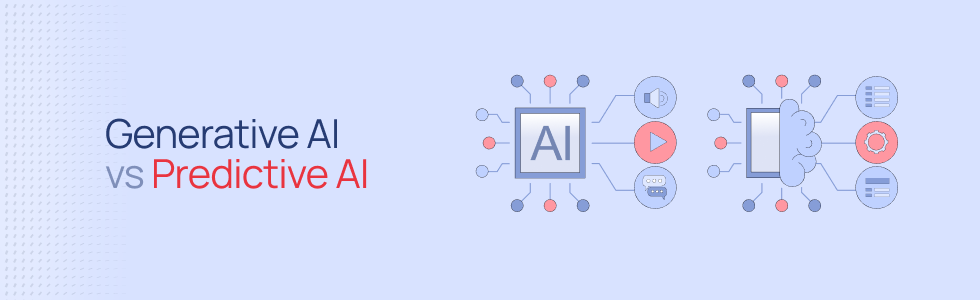
Generative AI provides new output after assessing data patterns whereas predictive AI analyzes historical data to provide forecasted or behavior based outputs. With the rapid advancement in AI models industry, both GenAI and predictive AI are used together for several operations.
Let’s break down key what is predictive AI vs generative AI and see generative AI vs predictive AI examples.
Key Takeaways
- The core difference in predictive vs generative AI is output type: creation vs prediction.
- Generative AI is widely used in chatbots, design, coding assistance, and content generation.
- Predictive AI is heavily used in forecasting, risk scoring, fraud detection, and demand planning.
- Many modern enterprise systems now combine types of AI generative vs predictive for better results.
Definition and Purpose of Generative AI
Generative AI is designed to produce new data that resembles the data it was trained on. Instead of just analyzing or classifying, it creates. It uses advanced deep learning architectures such as transformers and diffusion models to generate original outputs. These can include:
- Text
- Images
- Video
- Audio
- Software code
- Synthetic data
The main purpose of generative AI is creation and augmentation. It acts like a digital studio that never sleeps. That is why it is commonly being used for AI based virtual assistants.
The most common use cases of generative AI are:
- Content generation
- Conversational agents
- Design and media creation
- Code generation
- Knowledge assistants
- Synthetic dataset creation for testing
- Software testing
Also read what are AI agents and how generative AI is used in them.
Generative AI Examples
Right now, the most popular GenAI tools are:
- ChatGPT and other large language models generating text
- AI image tools creating artwork from prompts
- Code assistants writing functions and scripts
- AI video and voice generation systems
- Marketing copy and email generators
Definition and Purpose of Predictive AI
Predictive AI focuses on forecasting future outcomes based on historical and real-time data. It does not create new content. It estimates probabilities and trends. It uses machine learning models such as:
- Regression models
- Decision trees
- Random forests
- Gradient boosting
- Neural networks for prediction tasks
The purpose of predictive AI is to provide decision support. It helps organizations act earlier and smarter.
Most common use cases of predictive AI are:
- Demand forecasting
- Risk scoring
- Fraud detection
- Customer churn prediction
- Maintenance prediction
- Sales forecasting
- Health risk modeling
Predictive AI Examples
Predictive AI is less about creativity and more about probability. For example, it can be used for:
- Predicting which customers are likely to cancel a subscription
- Forecasting product demand next quarter
- Detecting fraudulent transactions in banking
- Predicting equipment failure in manufacturing
- Estimating loan default probability
Types of AI Generative vs Predictive
When comparing types of AI generative vs predictive, the difference shows up in model families and training goals.
Generative AI Model Types
- Large Language Models (LLMs): AI models trained on vast text data that generate and understand human language for tasks like writing, answering questions, and coding.
- Diffusion models for images and video: Generative models that create images or videos by gradually refining random noise into detailed visual content.
- Generative Adversarial Networks (GANs): Dual network systems where one model generates data and another critiques it to improve realism over repeated cycles.
- Transformer-based multimodal models: AI models built on transformer architecture that can process and generate multiple data types such as text, images, audio, and video together.
- Foundation models trained on massive datasets: Large, general purpose AI models pretrained on broad datasets that can be adapted to many downstream tasks.
Predictive AI Model Types
- Supervised learning models: Models trained on labeled data to predict outcomes based on known input and output examples.
- Time series forecasting models: Models designed to predict future values by analyzing patterns in time ordered historical data.
- Classification algorithms: Algorithms that assign data points into predefined categories or classes.
- Risk scoring systems: Predictive models that calculate the probability of negative or positive outcomes such as fraud, default, or churn.
- Recommendation ranking models: Models that predict user preferences and rank items in order of likely relevance or interest.
Differences Between Predictive vs Generative AI
| Aspect | Generative AI | Predictive AI |
| Core Objective | Creates new content and synthetic outputs | Forecasts outcomes and future events |
| Primary Purpose | Generate something new from learned patterns | Estimate what is most likely to happen |
| Output Style | Text, images, code, audio, video, designs | Probabilities, scores, labels, categories |
| Training Goal | Learns patterns to reproduce and remix data | Learns relationships to predict results |
| Interaction Style | Prompt driven and conversational | Data driven and analytics focused |
| User Experience | Interactive and creative workflows | Analytical and decision support workflows |
| Typical Inputs | Prompts, natural language, images, multimodal data | Structured and historical datasets |
| Typical Users | Marketing, design, engineering, content, support teams | Operations, finance, risk, supply chain, data teams |
| Business Role | Idea and content creation engine | Forecasting and decision intelligence engine |
| Example Tasks | Write blogs, generate UI, create code, design visuals | Predict churn, demand, fraud, credit risk |
| Speed Advantage | Rapid content and prototype generation | Rapid pattern based forecasting |
| Scale Advantage | Scales creative and knowledge production | Scales data driven decision models |
| Customer Impact | Enables personalized content and conversations | Enables targeted, likelihood based decisions |
| Innovation Value | Speeds ideation and experimentation | Improves planning and scenario accuracy |
| Operational Value | Automates drafts, designs, documentation | Optimizes inventory, staffing, resources |
| Risk & Control | Explains complex topics in simple language | Detects anomalies and fraud patterns |
| Decision Support Style | Generates multiple options and variants | Ranks options by probability and risk score |
| Use Case: Marketing | Generates campaign copy and creatives | Predicts segment response and conversion |
| Use Case: Sales | Drafts personalized outreach | Scores lead conversion likelihood |
| Use Case: Planning | Produces tailored campaign assets | Forecasts demand and trends |
| Use Case: Risk | Writes human readable risk summaries | Flags high risk transactions |
| Best When Used | You need creation and exploration | You need prediction and precision |
| Best Together | Creates options and content | Evaluates which options will work best |
Subscribe Newsletter for Latest Updates
Final Thoughts
If you need forecasts, risk signals, and trend detection, predictive AI is your compass. If you need creation, interaction, and content at machine speed, generative AI is your engine. And when both sit at the same table, businesses move from guessing and grinding to predicting and producing with precision.
Want to see generative AI in action? Check out our Generative AI & Machine Learning services.
FAQs
Is ChatGPT a Gen AI or Predictive AI Model?
ChatGPT is primarily a generative AI model. It generates text responses based on learned language patterns. Under the hood, it uses probability to predict the next token in a sequence, but its functional category is generative because its purpose is content creation and conversation.
Which AI Model Google Uses?
Google uses both generative and predictive AI models across its ecosystem. Generative models power tools like Gemini for text, code, and multimodal generation. Predictive AI powers search ranking, ad optimization, recommendations, spam detection, and forecasting systems. Large tech platforms rarely choose one type. They operate fleets of both.
What Are the Biggest AI Models?
The biggest AI models today are large foundation models trained on massive multimodal datasets. For example, Large language models with hundreds of billions or more parameters. Multimodal generative models that process text, image, audio, and video. Enterprise scale predictive models trained in billions of business events. Model size keeps growing, but efficiency and specialization are now just as important as raw scale.
Related Blogs

Transforming IT with AI to Unlock Efficiency, Security, and Innovation
The integration of AI in IT Businesses is no longer a futuristic concept. From automating…

What Are Emerging IT Solutions for SMBs in 2026?
Technology is changing quickly, and businesses are finding new ways to use it to work…
Generative AI in Software Testing Use Cases and Benefits
Software testing is no longer limited to scripted test cases and repetitive automation flows.